Redesign of data modeling in IBM Planning Analytics
Reducing a steep learning curve for modeling
The opportunity
From our end-users and business partners, we consistently heard that although Planning Analytics is a robust product, it has a steep learning curve, especially while setting up a model.
Creating a model is one of the key steps in a user's journey to begin planning. Because of the complexity involved, models are typically set up by trained consultants, or technical co-ordinators.
The goal of this project was to reduce the perceived complexity and enable users, without extensive training or deep technical skills, to get started with plans quicker. From a product strategy perspective, this would be a step towards reducing barrier to entry for new customers.
My role
Designer and researcher
Worked with
Offering Managers and other designers over different phases of the project.
User's journey through the planning process
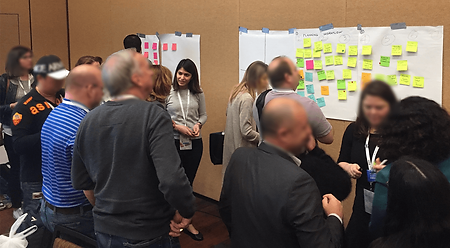
Participatory workshop with 40 customers and business partners

Workflows of different types of users during planning
Through 1:1 user interviews, a contextual inquiry and participatory workshops, I documented the current journey that different types of users typically follow while planning.
The journey map highlighted to our team that most companies have a complex planning process, involving several data artifacts, stakeholders, contributors and important deadlines.


Journey map of entire planning process. Highlight indicating dependencies and stakeholders involved in creating a model
Who is our target user?
Plan mangers often played the role of an ‘orchestrator’ and because of the product’s complexity, leaned heavily on technical team members to set up and maintain data models.
Our team’s objective was to reduce this friction early in the planning process, and help plan managers to get started quickly, given the extent of their responsibilities.
Through user interviews, we solidified our understanding of the main user - Danielle, a Planning & Budgeting Director.

Contextual inquiry with customer

Empathy map of proto-persona

Proto persona: Planning and Budgeting Director
Early concepts & sketching
The designers and offering managers together crafted the ideal to-be scenario for a Planning & Budgeting Director.
Through several iterations, we sketched an experience that guided Danielle through a step by step process to set up a new model tailored to her company's use-case.
Next, I worked on extending this concept to enable users that were not starting from scratch and could use existing artifacts to begin creating models.

Sketch: user is guided through steps to create model

Sketch: Various starting points for user to create a new model

Wireframe: user is guided through steps to create model
User feedback
Over 7-8 interviews and a conference workshop with about 45 participants, we shared the prototype to collect user feedback. Most users that we spoke to found value in the new guided experience, while a few expressed concern over technical jargon.
"Very guided process and makes a new planning manager very comfortable"
"Love the summary view of the whole planning process"
"Complicated for normal users who are not capable of thinking in dimensions"
"Step by step is useful. Need to be able to customize steps"

A glimpse of the next iteration
A few steps showing how a user might create a new model the guided template
Outcomes
Despite positive feedback from users and stakeholders, the implementation of this capability was delayed because of organizational changes.
For strategic reasons, this project was later forked into two, model creation and plan management. The prototype and positive user reception served as a solid base for the new Plans experience in IBM Planning Analytics.